
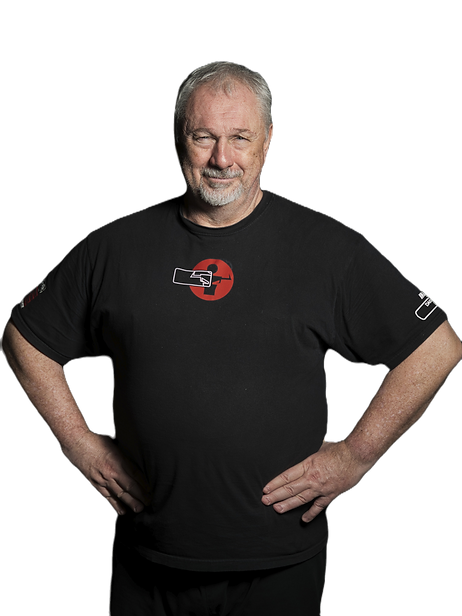
A LIFE DEDICATED TO MARTIAL ARTS
Jeff Espinous was born in 1963 in Paris. His martial arts journey began in 1968 with wrestling, followed by Viet Vo Dao two years later. In 1983 he encountered Filipino Martial Arts for the first time, at a seminar taught by Dan Inosanto in Paris — an encounter that would define the rest of his life. Between 1985 and 1989 he trained at the Inosanto Academy in Los Angeles under Dan Inosanto, Cass Magda, Paul de Thouars, Herman Suwanda, Larry Hartsell, and Ted Lucaylucay, traveling repeatedly to Southeast Asia to deepen his training in Filipino and Indonesian martial arts.
In 1989 he became the first dedicated FMA instructor in France. In 1992 he founded his own system, Kali Sikaran, and designed its first logo — the Bull. The following years saw him help found the European Kali Arnis Eskrima Federation, serve as its President, and become European Technical Director for Inayan Eskrima under Mangisurosuro Mike Inay, whose seminars he brought across Europe.
In 1995 he founded IKSA, the International Kali Sikaran Association, and published the first written Kali Sikaran program in 1998. Guided by Mike Inay before his passing, Jeff took the title of Punong Guro in 2004. Over the following years he was named Pendekar Muda and later Pendekar Wijaya in Pencak Silat, co-founding Pencak Silat Rampai in 2007.
In 2014, after 45 years in the martial arts and 30 years dedicated to Filipino Martial Arts, he was honored with the title Dakilang Guro as the creator of Kali Sikaran. In 2016 he rebranded the system once more, as Kali Silat Evolution KSE, the international community it is today.
TEACHERS AND COMPANIONS
Jeff's path crossed with an extraordinary number of teachers across three worlds of martial arts, and he spoke of each with the same gratitude that closes his own words above. (A † marks a teacher who has since passed away himself.)
In Filipino Martial Arts — beyond his years at the Inosanto Academy in Los Angeles under Dan Inosanto, Cass Magda, Paul de Thouars, Herman Suwanda, Larry Hartsell†, and Ted Lucaylucay† — Jeff trained and worked with:
-
Bobby Breen — Kali JKD, 4D Combat
-
Richard Bustillo† — Cacoy Doce Pares, Jun Fan Jeet Kune Do
-
Cacoy Cañete† — Cacoy Doce Pares
-
Krishna Godhania — Warrior Eskrima
-
Emanuel Hart — Inayan System of Eskrima
-
Larry Hartsell† — Jun Fan JKD Grappling
-
Mike Inay† — Inayan System of Eskrima
-
Dan Inosanto — Inosanto Kali, Maphilindo Silat, JKD
-
Dieter Knüttel — Modern Arnis
-
Ted Lucaylucay† — Lucaylucay Kali/JKD
-
Cass Magda — Inosanto Kali, Maphilindo Silat, JKD
-
Russ Rhodes — Ken Ju Ryu, Kempo Ju Jitsu
-
Jack Santos† — Balintawak
-
Johan Skålberg — Modern Arnis, Kombatan — with whom he would later share the ranks given by Mike Inay himself
-
Jon C. Ward — Inayan System of Eskrima
In Pencak Silat, he trained and worked with:
-
Paul de Thouars† — Pencak Silat Bukti Negara
-
Dan Inosanto — Inosanto Kali, Maphilindo Silat, JKD
-
M. Barie Irsjad† — Pencak Silat Tapak Suci
-
Cass Magda — Inosanto Kali, Maphilindo Silat, JKD
-
Haryadi Mawardi† — Pencak Silat Tapak Suci
-
Pak† — Pencak Silat Pukulan Madura
-
Joko Suseno — Pencak Silat Tapak Suci — alongside whom he would later co-found Pencak Silat Rampai
-
Herman Suwanda† — Pencak Silat Mande Muda
And beyond the Filipino and Indonesian arts that formed the core of his system, Jeff trained across a wide range of other disciplines and teachers:
-
Salem Assli† — Boxe Française, Savate, Kali, JKD
-
Didier Aubry — Tae Kwon Do
-
Brad Fowler — Boxing, Kick Boxing
-
Ho† — Viet Vo Dao
-
Lee Kwon Young — Tae Kwon Do
-
Roger Lafond† — Savate, Canne, Bâton, Panache
-
Russ Rhodes — Ken Ju Ryu, Kempo Ju Jitsu — under whom he earned his Kyoshi rank
-
Sku† — Muay Thai, Muay Boran, Krabi Krabong
Several of the teachers who shaped him have since passed away themselves — a lineage Jeff carried forward, and one that now continues through those he trained in turn.
THE TEACHER WE KNEW
Words alone can never fully capture a person's character, memory, or legacy. This tribute focuses on one meaningful part of his life: the art he shared with every willing student, and the dedication and joy with which he embraced that calling.
Always an innovator, he had a remarkable ability to see what others could not: the hidden essence and simplicity within all martial arts. He dissolved complexity and gave martial arts a tangible, reproducible process of discovery — a gift he shared with everyone privileged enough to train with him.
"Jeff was a movement genius, a creator, an innovator. It was captivating to watch him in action. He had a thousand answers for every attack and delivered each one with grace, poise, power, and elegance." — GM Sunny Graff
When a student once asked, "After all these years of training, where do you find inspiration?" he simply looked at the student and replied, "You. You inspire me to become better and keep moving forward. I do not yet know what you may need on your journey, but it is my honor and privilege to help you discover it. You are my inspiration."
He had a rare gift of making each person feel seen, valued, and capable. Jeff believed in his students — often before they were able to believe in themselves — and that belief helped them move forward with confidence, in martial arts and in life.
What brought him the greatest pride was watching a student take what he had shared and shape it into their own expression — helping others discover that kind of personal freedom. He had an instinctive way of guiding you just beyond your comfort zone while reassuring you that you would be okay. He helped you grow, and you always left his presence with a smile.
He encouraged his students to "look over the fence" by training in other martial arts and learning from other instructors. To him, this was not a departure from their path, but an important part of it — exploring beyond one system made students stronger, broadened their understanding, and gave them a more complete approach to learning and growth. His message was simple: the better each student became, the stronger the whole group became.
To Jeff, his students were not simply part of his group; they were the group, and they were his family, nurtured, encouraged, and supported as one. That sense of belonging was clear even to new students, who often remarked that they felt welcomed and supported from the moment they began training. It is this feeling we hope will continue in his absence. Jeff gave us a lasting example of how to conduct ourselves and how to support others, both in martial arts and in life.
HIS LEGACY TODAY
Kali Silat Evolution continues to carry forward what Dakilang Guro Jeff Espinous built — across more than a dozen countries, through the instructors he trained and the ones they, in turn, have taught.
That work today is carried by Kali Silat International, the organization behind the Kali Silat Evolution name. Its role isn't to keep the system standing still, but to keep it moving the way Jeff always meant it to: training instructors, opening new schools, and holding every practitioner — wherever they train — to the same standard he set from the beginning. First it's your skill level that matters, not the time you spend with us. That is still the measure today, and it's how his legacy stays alive in practice rather than only in memory.
THE BULL
The story behind our logo

Dakilang Guro Jeff Espinous designed the first version of the Bull in 1992, for the Second Modern Arnis Summercamp in Lübeck, Germany. Its inspiration came from the Majapahit Empire — a civilization he would return to again and again in explaining what the symbol means.
The second version followed in 1993, designed by one of his own students, Guillaume Boube, at a time when the logo carried the name of his first French association, MMA — Majapahit Martial Arts.
A third version came in 1995. Carried worldwide from the year 2000 onward, this remained the version most widely associated with the system for over a decade.
In 2010, Jeff felt it was time to write a new chapter, and redesigned the Bull for the fourth time. He released this version in full in 2014 — reserved, at first, for students who had reached the rank of Guro, 5th Dan and above. In 2016, as he reshaped his life's work once more under the name Kali Silat Evolution, the Bull followed him into this new chapter too. As he put it himself: after more than thirty years, he had finally found the philosophy that belonged with it.

What the Bull represents
The symbol reaches back to the Majapahit Empire, a powerful civilization that once stretched from Sumatra to New Guinea between 1293 and 1500. Legend holds that Majapahit brought together some of the finest fighters of Southeast Asia — practitioners of Kali from the Philippines, Muay Boran and Krabi Krabong from Thailand, Pencak Silat from Indonesia and Malaysia — each carrying their own art.
Within that empire, the bull stood as a symbol of strength and power. Jeff took that same symbol as a bridge between Kali, Muay Boran, and Pencak Silat — the three arts at the foundation of the system. In his own words, the Bull represents "a true balance between strength and power, between body and mind." Above it, the circle stands for spiritual strength, and a higher understanding.
One logo, many layers
The version Jeff released in 2014 carries more than one meaning. Its rectangle represents the shared foundation of the KSE curriculum — what he called "our common language." But like the system itself, its meaning does not stop there. It deepens as a practitioner progresses through the ranks, revealing more with every level reached.